
Google A0B7FY
| eröffnet am: | 26.10.04 11:47 von: | WALDY |
| neuester Beitrag: | 31.01.24 13:33 von: | Tamakoschy |
| Anzahl Beiträge: | 1011 | |
| Leser gesamt: | 598379 | |
| davon Heute: | 15 | |
bewertet mit 10 Sternen |
||
|
|
||

Sollte niemanden beeinflussen. Ich wollte das nur mal niederschreiben,
was mir gerade durch den Kopf ging beim lesen des Artikels.
Sihe hierzu mein posting:
http://www.ariva.de/...mt_s_ganz_dick_t259625?pnr=3538072#jump3538072
Gruß
Casaubon
Passend zum Schein:
Google
Inside the Googleplex
Aug 30th 2007 | SAN FRANCISCO
From The Economist print edition
It is rare for a company to dominate its industry while claiming not to be motivated by money. Google does. But it has yet to face a crisis
| |
 | |
IN AMERICA a phenomenon might claim to have entered mainstream culture only after it has been satirised on “The Simpsons”. Google has had that honour, and in a telling way. Marge Simpson types her name into Google's search engine and is amazed to get 629,000 results. (“And all this time I thought ‘googling yourself' meant the other thing.”) She then looks up her house on Google Maps, goes to “satellite view” and zooms in. To her horror, she sees Homer lying naked in a hammock outside. “Everyone can see you; get inside,” she yells out of the window, and the fumbling proceeds from there.
And that, in a nutshell, sums up Google today: it dominates the internet and guides people everywhere, such as Marge, to the information they want. But it also increasingly frightens some users by making them feel that their privacy has been intruded upon (though Marge, technically, could not have seen Homer in real time, since Google's satellite pictures are not live). And it is making enemies in its own and adjacent industries. The grand moment of Marge googling herself, for example, was instantly available not only through Fox, the firm that created the animated television show, but also on YouTube, a video site owned by Google, after fans uploaded it in violation of copyright.
Google evokes ambivalent feelings. Some users now keep their photos, blogs, videos, calendars, e-mail, news feeds, maps, contacts, social networks, documents, spreadsheets, presentations, and credit-card information—in short, much of their lives—on Google's computers. And Google has plans to add medical records, location-aware services and much else. It may even buy radio spectrum in America so that it can offer all these services over wireless-internet connections.
Google could soon, if it wanted, compile dossiers on specific individuals. This presents “perhaps the most difficult privacy issues in all of human history,” says Edward Felten, a privacy expert at Princeton University. Speaking for many, John Battelle, the author of a book on Google and an early admirer, recently wrote on his blog that “I've found myself more and more wary” of Google “out of some primal, lizard-brain fear of giving too much control of my data to one source.”
Google itself has been genuinely taken aback by such sentiments. The Silicon Valley company, which trumpeted its corporate motto, “Don't be evil”, before its stockmarket listing in 2004, considers itself a force for good in the world, even in defiance of commercial logic. Its founders, Larry Page and Sergey Brin, and Eric Schmidt, its chief executive, have said explicitly and repeatedly that their biggest motivation is not to maximise profits but to improve the world.
[...]
That share price has quintupled since 2004, making Google worth $160 billion. The company has not yet had its tenth birthday. Yet Piper Jaffray, an investment bank, expects it to have revenues of $16 billion and profits of $4.3 billion this year. With so much money pouring in sceptics say it is easy to ignore shareholders and talk about doing good instead of doing well. But what happens when earnings fall short of Wall Street expectations or some other disaster strikes? Yahoo! and other rivals have gone through such crises and been humbled. Google has not.
Google's success still comes from one main source: the small text ads placed next to its search results and on other web pages. The advertisers pay only when consumers click on those ads. “All that money comes 50 cents at a time,” says Hal Varian, Google's chief economist. For this success to continue, several things need to happen.
First, Google's share of web searches must remain stable. Thanks to its brand, this looks manageable. Google's share has steadily increased over the years. It was about 64% in America in July, according to Hitwise. That is almost three times the volume of its nearest rival, Yahoo!. In parts of Europe, India and Latin America, Google's share is even higher. Only in South Korea, Japan, China, Russia and the Czech Republic does it trail local incumbents.
Second, Google must maintain or improve the efficiency with which it puts ads next to searches. And here its dominance is most impressive. In a recent analysis by Alan Rimm-Kaufman, a marketing consultant, it took a whopping 73% of the budgets of companies that advertise on search engines (versus 21% and 6%, respectively, for Yahoo! and Microsoft). It charged more for each click, thanks to its bigger network of advertisers and more competitive online auctions. And it had far higher “click-through rates”, because it made these ads more relevant and useful, so that web users click on them more often.
Perhaps most tellingly, advertisers do better with Google. Mr Rimm-Kaufman found that Google's ads “converted” more often into actual sales, which tended to be larger than those originating from Yahoo! or Microsoft. This is astonishing, given that Yahoo! has just spent a year on an all-out effort, codenamed Panama, to close precisely these gaps.
But even lucrative “pay-per-click” has limits, so Google is moving into other areas. It is trying (pending an antitrust inquiry) to buy DoubleClick, a firm that specialises in the other big online-advertising market, so-called “branded” display or banner ads (for which each view, rather than each click, is charged for). And Google now brokers ads on traditional radio stations, television channels and in newspapers of the dead-tree sort.
Sceptics point out that with each such expansion, Google reduces its profit margins, because it must share more of the revenues with others. If a web surfer clicks on a text ad placed by Google on a third-party blog, for instance, Google must share the revenue with the blogger. If Google places ads in newspapers or on radio stations, it must share the revenues with the publisher or broadcaster.
Yet Google does not look at it that way. Its costs are mostly fixed, so any incremental revenue is profit. It makes good sense for Google to push into television and other markets, says Mr Varian. Even if Google gets only one cent for each viewer (compared with an average of 50 cents for each click on the web), that cent carries no variable cost and is thus pure profit.
The machinery that represents the fixed costs is Google's secret sauce. Google has built, in effect, the world's largest supercomputer. It consists of vast clusters of servers, spread out in enormous datacentres around the world. The details are Google's best-guarded secret. But the result, explains Bill Coughran, a top engineer at Google, is to provide a “cloud” of computing power that is flexible enough “automatically to move load around between datacentres”. If, for example, there is unexpected demand for Gmail, Google's e-mail service, the system instantly allocates more processors and storage to it, without the need for human intervention.
This infrastructure means that Google can launch any new service at negligible cost or risk. If it fails, fine; if it succeeds, the cloud makes room for it. Thus Google can redefine its goals almost on a whim. Its official strategy recently became “search, ads, and apps”—the addition being the apps (ie, software applications). Sure enough, after a string of acquisitions, Google now offers a complete alternative to Microsoft's entrenched Office suite of programs, all accessible through any web browser. A new technology, called Google Gears, will make these applications usable even when there is no internet connection. And Google is hawking these applications not only to consumers but also to companies. Ultimately it does so because, thanks to its supercomputer, it can.
With Google's cashflow and infrastructure, the freedom to do anything it fancies gives rise to constant rumours. Often, these are outrageous. It used to be conventional wisdom that Google would build cheap personal computers for poor countries. This turned out to be nonsense, because Google does not want to make hardware. Now there is talk of a “Gphone” handset. This is also unlikely because Google is more interested in software and services, and does not want to alienate allies in the handset industry—including Apple, which shares board directors with Google and uses Google software on its iPhone.
Sometimes the rumours are both outrageous and true. Google is experimenting with new ways of bringing broadband connections to consumers, by blanketing parts of Silicon Valley with Wi-Fi networks. It is planning to enter an auction for valuable radio spectrum in America, and thinking of radically new business models to make money from wireless data and voice networks, perhaps a free service supported by ads.
Beyond its attempts to expand into new markets, the big question is how Google will respond if its stunning success is interrupted. “It's axiomatic that companies eventually have crises,” says Mr Schmidt. And history suggests that “tech companies that are dominant have trouble from within, not from competitors.” In Google's case, he says, “I worry about the scaling of the company.” Google has been hiring “Nooglers” (new Googlers) at a breathtaking rate. In June 2004 it had 2,292 staff; this June the number had reached 13,786.
Its ability to get all these people has been a competitive weapon, since Google can afford to hire talent pre-emptively, making it unavailable to Microsoft and Yahoo!. Google tends to win talent wars because its brand is sexier and its perks are fantastically lavish. Googlers commute on discreet shuttle buses (equipped with wireless broadband and running on biodiesel, naturally) to and from the head office, or “Googleplex”, which is a photogenic playground of lava lamps, volleyball courts, swimming pools, free and good restaurants, massage rooms and so forth.
Yet for some on the inside, it can look different. One former executive, now suing Google over her treatment, says that the firm's personnel department is “collapsing” and that “absolute chaos” reigns. When she was hired, nobody knew when or where she was supposed to work, and the balloons that all Nooglers get delivered to their desks ended up God knows where. She started receiving detailed e-mails “enforcing” Google's outward informality by reminding her that high heels and jewellery were inappropriate. Before the corporate ski trip, it was explained that “if you wear fur, they will kill you.”
Google is a paradise only for some, she argues. Employees who predate the IPO resemble aristocracy. Engineers get the most kudos, people with other functions decidedly less so. Bright kids just out of college tend to love it, because the Googleplex in effect replaces their university campus—with a dating scene, a laundry service and no reason to leave at weekends. Older Googlers with families tend to like it less, because “everybody, even young mums, works seven days a week.”
[...]
Not everybody is impressed. The server logs will still exist for 18 months. And the cookies of “active” users will be automatically renewed upon expiry. This includes everybody who searches on Google, which in effect means most internet users. Then there is the matter of all that other information, such as e-mail and documents, that users might keep in Google's “cloud”. Mr Schmidt points out that such users by definition “opt in”, since they log in. They can opt out at any time.
As things stand today, Google has little to worry about. Most users continue to google with carefree abandon. The company faces lawsuits, but those are more of a nuisance than a threat. It dominates its rivals in the areas that matter, the server cloud is ready for new tasks and the cash keeps flowing. In such a situation, anybody can claim to be holier than money. The test comes when the good times end. At that point, shareholders will demand trade-offs in their favour and consumers might stop believing that Google only ever means well.
 |
|
| Copyright © 2007 The Economist Newspaper and The Economist Group. All rights reserved. |
|
|
<!-- Preview mode!! --><!-- START google ppc tracking --> <iframe src="http://switch.atdmt.com/iaction/oy6ats_EconomistcomLandingPage_1" width="1" height="1" frameborder="0" scrolling="No" marginheight="0" marginwidth="0" topmargin="0" leftmargin="0"> </iframe> <!-- END google ppc tracking --><!-- v_DevServer: 0 --><img src="http://stats.surfaid.ihost.com/crc/images/uc.GIF?1.20&economi&economi&noscript" height="1" width="1" alt="" border="0" /> <!-- esn: www3 -->
und Apple kontert mit dem iString, gezahlt wird per iPay. Wobei ich persönlich immer noch uPay bevorzugen würde.
Aber Schluss mit lustig und zurück zu google:
_____________________________________
Mit Google einkaufen per SMS
04. Sep 13:20 (netzeitung.de, nicht die beste Quelle, bin aber grad zu faul zum googlen ;)Google hat sich in den USA mit Gpay ein Handy-Bezahlsystem patentieren lassen, das der Kreditkarte Konkurrenz machen soll. Nun fehlt nur noch das passende Handy.
Der US-Suchmaschinenbetreiber Google will mit Gpay ein Handy-Bezahlsystem einführen. Ein entsprechender Antrag beim US-Patentamt wurde im Februar eingereicht und nun veröffentlicht, wie IT-Fachportale am Dienstag berichteten. Käufer sollen demnach per SMS mit ihrem Mobilfunktelefon bezahlen können. Die Kurznachricht mit Informationen über den Kaufbetrag gehe an eine Stelle, die den Bezahlvorgang abwickle. Danach sollen sowohl Käufer als auch Verkäufer eine Bestätigungsnachricht über den Erfolg der Transaktion erhalten.
Bei Googles Gpay soll es sich nach Unternehmensangaben um ein universell einsetzbares System handeln, das über die bisherigen SMS-Bezahlsysteme etwa für Parkscheine oder Bahntickets hinausgeht. Gpay wird von Google als Alternative zu Kreditkarten gesehen und soll auch beim Handel unter Privatpersonen zum Einsatz kommen.
Seit Monaten halten sich Gerüchte, dass Google an der Entwicklung eines eigenen Handys arbeitet. (nz)
__________________
ignorance is bliss
Der Kurs rockt ja nicht so richtig los – im Vergleich zu Apple, nachdem die ersten Gerüchte um das iPhone den Markt erreichten. Persönlich sehe ich die Position von Google im Mobile-Bereich sehr stark: Plattform-unabhängig bieten sie bereits jetzt integrative Services im Netz (Mail, Calendar, Text&Spreadsheets, News, Maps, ...), die Anwendungen lassen sich schon länger auch mobil nutzen. Der Reiz dabei liegt in den geringen Kosten: Die Web-Anwendungen sind eh' umsonst, easy zu administrieren (auch um sie für Teams nutzbar zu machen) und auf dem Telefon nutzbar zu machen. GMail, Maps und alle Funktionen der google-Suche funktionieren bestens auf meinem Symbian60-Telefon, über WLAN im Netz ohne einen cent Kosten. Wenn google nun auch einen VoIP-Service anbietet – umsonst und Werbefinanziert sehe ich da enormes Potential. Den Kunden wird erspart, verschiedene Dienste zu konfigurieren und die Benutzeroberfläche kann selbst bei neuen Services jeder intuitiv bedienen.
Bin gespannt, welchen Markt sich das Gphone erobern wird.

Ich denke an sich doch, dass Apple und google grundsätzlich verschiedene Strategien verfolgen. Die Zielgruppen überschneiden sich sicherlich weitgehend, doch erfolgt eine völlig unterschiedliche Ansprache – d.h. Apple weckt die einen, google die anderen Bedürfnisse. Aber wenn bei google noch ein verspäteter Ausbruch kommt, kommt er heftig.
Interessante Infos noch in unten stehendem Artikel aus dem economist... apple&google, google&apple, witzige idee.
__________________________________________________
Mobile phones
From iPhone to gPhone?Sep 13th 2007 | SAN FRANCISCO
From The Economist print edition
Silicon Valley is causing a stir in the wireless industry
JUST 74 days after launching its iPhone, Apple said this week that it had already sold 1m of the things—a milestone that its previous blockbuster product, the iPod, took almost two years to reach. Its appetite thus whetted, Apple has now cut the iPhone's price from $599 to $399 in a bold grab for the mass market. And yet, to judge by the industry's chatter, the iPhone is already old news. More excitement swirls around rumours that Google, the web-search giant that is Apple's neighbour in Silicon Valley, could enter the market with its own “gPhone”. Google's boss, Eric Schmidt, has already said that the firm plans to bid for a prime slice of American wireless spectrum in a forthcoming auction, something Apple is also said to be considering. In short, both mobile operators and handset-makers could soon be confronted with two of the world's sexiest brands as direct rivals.
Publicly, Apple and Google are being diplomatic so far. The industry is a stool with three legs—network service, devices, and the software and content that goes on them—and “I don't think any player in the ecosystem trying to glue it all together will be very successful,” says Dipchand Nishar, who leads Google's mobile-phone strategy. By this he may simply be conceding the obvious, which is that Google would not build hardware, even if it made the other two legs. (Previous rumours that Google would launch a low-cost personal computer proved to be unfounded.)
But Google seems to be up to something. It bought a company called Android in 2005 that specialises in mobile-phone software. It has Google Talk, a free internet-calling service. In July it bought GrandCentral Communications, a firm that gives users one single phone number for life. And it recently filed a patent application for a new mobile-payment technology.
[...]
It would certainly be tempting to tie all these bits together into a new software “platform” for mobile phones and offer it to handset-makers as an alternative to existing smart-phone operating systems such as Symbian, Palm or Microsoft's Windows Mobile. Naturally, Google's search, e-mail and document services would be tightly integrated, along with its advertising technologies, which might pave the way for mobile service that is partly or wholly subsidised by advertising.
As a strategy, this might be just different enough from Apple's to assure harmony with its ally. Mr Schmidt sits on both companies' boards, as does Arthur Levinson, the boss of Genentech, a biotech firm. Google also supplies map and video software for Apple's iPhone. It would suit neither firm to open hostilities. So Google may concentrate on software for cheaper, mass-market devices, leaving Apple to make elegant, high-end hardware.
[...]
Hardware aside, the more intriguing possibilities concern the spectrum auction. Next year America's Federal Communications Commission (FCC), the telecoms and media regulator, will sell a band of radio wavelengths that will become available in 2009 as television broadcasters migrate from analogue to digital technology.
The usual buyers for such spectrum would be America's existing telecoms operators, such as AT&T and Verizon. Their “walled garden” model does not allow consumers to choose among handsets, operators and software applications, or even to roam around the open internet. In July, however, Mr Schmidt sent a letter to the FCC in which he pledged to enter the bidding, provided the FCC forces any winner to open up the new network.
The FCC accepted some but not all of Google's advice, so the winner will have to give consumers the freedom to choose handsets and applications. Mr Schmidt declares himself happy enough and says that Google will “be a player in some form”, either alone or in concert with partners. Such as Apple, perhaps?
_________________
ignorance is bliss
Software / 18.09.2007 / 10:06 | Quelle: http://www.golem.de/0709/54825.html |
Google startet seinen Powerpoint-Konkurrenten
Aus Google Text & Tabellen wird Google Docs

|
Google Text & Tabellen, das nun auf den Namen Google Docs hört, wurde um eine Präsentationssoftware erweitert. Wer sich in den Dienst unter documents.google.com einloggt, kann dort nun neue Präsentationen erstellen oder bestehende hochladen und bearbeiten. Dabei akzeptiert Google derzeit Präsentationen in Microsofts Powerpoint-Format, nicht aber Präsentationen in Microsofts Office-Open-XML- oder OpenDocument-Format.
Dabei legt Google den Schwerpunkt auf die gemeinsame Erstellung von Präsentationen, wohl einer der wesentlichen Vorteile des Online-Ansatzes. Mehrere Personen können gleichzeitig an einer Präsentation arbeiten und werden dabei wie bei den anderen Office-Applikationen von Google an der rechten Seite des Browser-Fensters angezeigt.
| Video: Google erklärt Google Docs |
Google will seine Präsentationssoftware aktiv weiterentwickeln und verspricht für die kommenden Wochen und Monate neue Funktionen.
Google Docs läuft derzeit nur im Internet Explorer für Windows ab Version 6.0 (ausgenommen IE 6.0.26), Firefox ab Version 1.0.7, Mozilla ab Version 1.7.12 und Netscape 7.2 sowie 8.0. Safari und Opera werden derzeit nicht unterstützt. Die Software steht kostenlos zur Verfügung, die Nutzung setzt lediglich einen Google-Account voraus. (ji)
Das Internet-Unternehmen Google wird an der Börse auf einem neuen Höchststand bewertet. Das Unternehmen hatte zum Wochenschluss einen Wert von knapp 175 Milliarden Dollar. Die Aktie startete 2004 bei einem Ausgabepreis von 85 Dollar, gegenwärtig kostet sie 560 Dollar. Dieser Höhenflug bringt nicht zuletzt den beiden Firmengründern reichen Geldsegen.
Die Google-Aktien haben zum Wochenschluss mit einem Kurs von 560,10 Dollar einen Höchststand erreicht. Der weltgrösste Suchmaschinen-Betreiber wird an der Börse damit zu 174,8 Mrd. Dollar bewertet.
Die Google-Aktie war 2004 mit einem Kurs von 85 Dollar an der Börse gestartet.
http://www.nzz.ch/nachrichten/wirtschaft/aktuell/...and_1.559680.html
Ich geb's zu, die Meldung ist schon etwas älter – aber eine der interessanteren und wichtigeren Natur. Wenn google-aps durchschlägt, könnte google irgendwann (auch in Verbindung der Usability des Systems über ein eigenes Mobil-Gerät und -Netz) in punkto Verbreitung Microsoft in die Schranken weisen. Dass die Zukunft in plattformunabhängigen, online-verfügbaren Software-Lösungen liegt, wurde ja schon oft orakelt. Aus gegebenem Anlass auch noch ein Chart im Anhang.
__________________________________
Capgemini Embraces Google Apps
September 10, 2007 By Clint Boulton (http://www.eweek.com/print_article2/0,1217,a=214765,00.asp)
Capgemini has agreed to provide Google Apps Premier Edition, Google's enterprise applications suite, to its vast client list, giving Google a potential giant boost in customer adoption.
Financial terms of the deal, to be announced Sept. 13, were not made public. But the deal is a sign that the broader business market is set to accept hosted SAAS (software as a service) and Google Apps as an alternative to Microsoft Office in the enterprise.
Google has more than 100,000 businesses using the portfolio, but should be able to boost that figure considerably with Capgemini, one of the biggest IT consulting companies, as an ally.
Google and Capgemini are not championing the agreement as a coup against Microsoft's dominance in the office applications space, as Capgemini has pledged to offer customers both GAPE and Office as part of its desktop and distributed services offering. However, the simple SAAS delivery model could easily help the outsourcing vendor expand GAPE's reach to the more than 1 million desktop users it already supports, New York-based Capgemini told eWEEK.
"We're seeing a lot of interest from the large companies and we think the partnership with Capgemini is going to help springboard that adoption," Rajen Sheth, product manager for Google Apps, based in Mountain View, Calif., told eWEEK. "They know these large companies and they can help refine the product and help spot the places within these companies where Google Apps can work very well."
Google turned the IT market on its ear when it unveiled GAPE in February, as many industry experts saw the suite as a threat to Microsoft's Office suite.
GAPE is piped over the Internet via a Web browser and includes word processing, spreadsheet, e-mail and other capabilities for $50 per user per year. Unlike with Microsoft Office, clients who use the software don't have to install or maintain any software locally.
Steve Jones, head of SOA (service-oriented architecture) for Capgemini's global outsourcing unit, said Capgemini recognized the allure of GAPE after company officials whipped up a white paper with the Google Docs word processing application in two weeks.
With traditional word processing software, such as Microsoft Word, all of the cutting, pasting, merging and collaboration would have taken two months, Jones said.
He added that Capgemini will be able to help its own customers solve similar problems by simplifying content creation in heterogeneous technology environments.
But GAPE is not without its flaws. Guy Creese, an analyst at the Burton Group research firm, declared in a report in August that the lack of records management capabilities and the company's original conception of Google Apps as being for consumer use could put a crimp in any Google plans to infiltrate the business market.
Capgemini expects to be judicious in deploying GAPE and Microsoft Office. "This isn't about offering one or the other," Jones said. "This is about offering both and finding out where does the business case stack up for a power suite like Microsoft and where does the business case stack up for a collaborative suite like Google and integrating the two worlds together. … This is about two $10 billion corporations that are combining some of their existing offers to offer increased choice and flexibility into the enterprise market."
__________________
ignorance is bliss
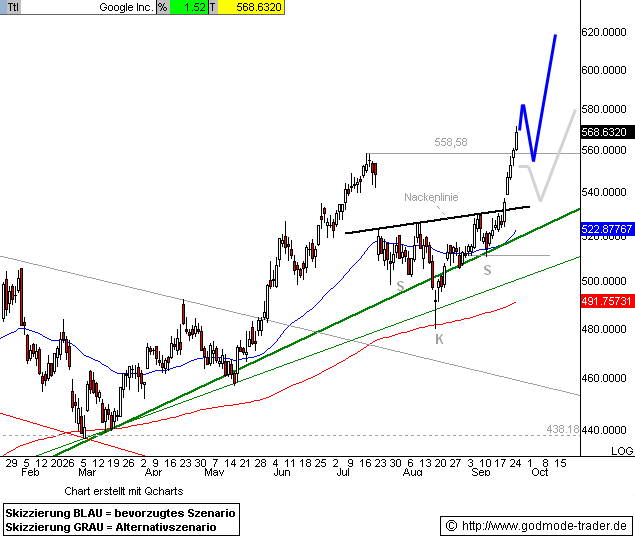
goog_nyse_ytd_070925.png (verkleinert auf 50%)

Börse: Nasdaq in USD / Kursstand: 568,63 $
Kursverlauf vom 24.01.2007 bis 24.09.2007 (log. Kerzenchartdarstellung / 1 Kerze = 1 Tag)
Kurz-Kommentierung: Die GOOGLE Aktie generierte mit der Vollendung einer bullischen, inversen SKS als Bodenformation am 18.09.2007 ein Kaufsignal, worauf wir betont hingewiesen haben (s. angehängte Chartdokumentation). Die Folge war eine steile Kursrallye und ein Ausbruch auf ein neues AllTimeHigh. Idealerweise markiert die Aktie in Kürze ein Zwischenhoch im Berech bei 575,00 - 583,00 $ und vollzieht anschließend einen Rücksetzer bis 552,80 - 558,58 $. Mittelfristig sollte die gestartete Kursrallye weiter bis 700,00 und langfristig ca. 1000,00 $ fortgesetz! t werden.
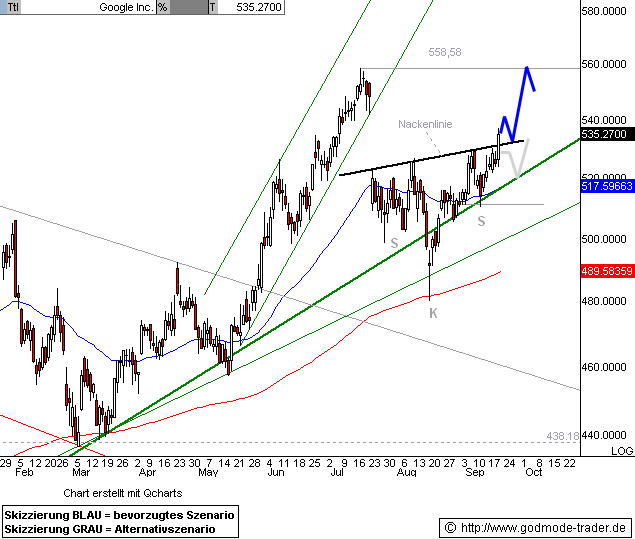
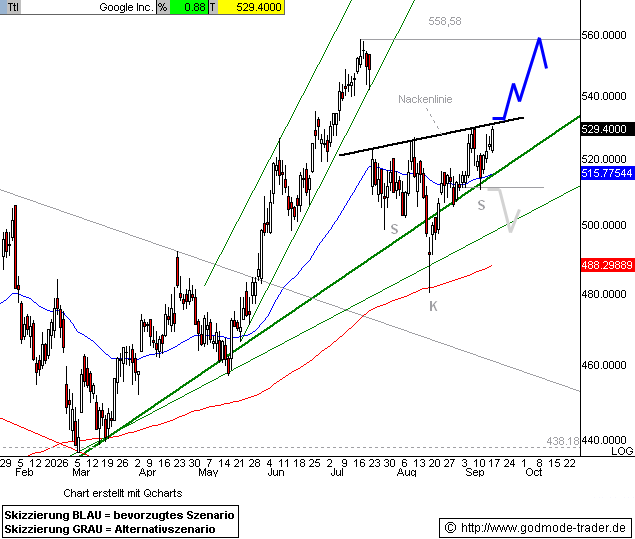
Charts der Vorgängeranalysen:
Quelle: http://www.godmode-trader.de
Gruß Moya
xpfuture
ps. wollte eigéntlich schon seit 100 usd d.h. seit emmission shorten.
mfg
ath
PS. habs aber nicht getan u. ich dachte schon damals, solche chnacen wie bei msft, gibts nie wieder ;-((
Just hours after Lehman Brothers issued a report Tuesday stating that the so-called Gphone "could launch as early as February 2008," Google (Charts, Fortune 500) announced it purchased Jaiku, a Helsinki-based company that develops blogging software for the mobile phone.
"The mobile world has much greater reach than the wired Internet," says Avi Greengart, a principal analyst with research firm Current Analysis. "Google sees this as the future."
Google's bold entry into the cell phone market promises to shake up the $127 billion wireless industry. The company has made no secret that it believes mobile phones should be free to consumers, where revenues are generated through advertising and no single carrier has a lock on users.
In the short run, the Gphone also threatens to dethrone the Apple iPhone as the wireless industry's newest star. Google and Apple (Charts, Fortune 500) have worked closely in the past, but the Gphone could test that cozy relationship and force Apple to make the iPhone a more open device than it is today.
A Google spokesperson would not comment on the company's plans, but there's no question that the Internet giant has ambitious plans for the mobile market.
...full article at http://money.cnn.com/2007/10/09/technology/...?postversion=2007101108
Erstes Forschungs- und Entwicklungszentrum in Deutschland
Google hat sein erstes Forschungs- und Entwicklungszentrum in Deutschland eröffnet. Mit dem neuen Münchner Standort Marienhof will Google die Bedürfnisse deutscher Nutzer besser in die Produktentwicklung einfließen lassen.
Neben IT-Experten und Ingenieuren im Forschungs- und Entwicklungsbereich sind in dem heute eröffneten Büro auch Mitarbeiter in Business-Bereichen wie Werbevermarktung, Geschäftskunden und Partnerschaften beschäftigt. "Heute legen wir den Grundstein dafür, dass bald schon Innovationen aus Deutschland global Einzug in die Google-Produktwelt halten werden", erklärt Dr. Nelson Mattos, Vice President Engineering EMEA bei Google.
München sei die Heimat vieler hoch talentierter IT-Wissenschaftler und Software-Ingenieure und somit ein idealer Standort für Google, meint Mattos.
In Deutschland ist Google bereits seit 2001 mit seinem ersten Standort in Hamburg vertreten. Bis heute wurden weitere Büros in Düsseldorf, Frankfurt am Main und Berlin eröffnet. Europäische Forschungs- und Entwicklungszentren unterhält das Unternehmen neben München zudem in Aarhus (Dänemark), Dublin (Irland), Krakau (Polen), London (Großbritannien), Lulea (Schweden), Moskau und St. Petersburg (Russland), Trondheim (Norwegen) und Zürich (Schweiz). (ji)
Quelle: http://www.golem.de/0710/55408.html
antwort: black swan exposure. wer weiss, wenn es klappt, 10x ist möglich. dies bez. würde das buch: "Black Swan" von Taleb empfehlen.
11.11.2007, 16:00 Uhr
Es wird eine entscheidende Woche für Google. Spätestens am Dienstag wird die EU-Kommission entscheiden, ob sie die Übernahme des Online-Werbedienstleisters Doubleclick durch Google genehmigen, oder in eine vertiefte Prüfung einsteigen wird. Letzteres würde Google empfindlich treffen und dem Konkurrenten Microsoft helfen, massiv aufzuholen.DÜSSELDORF. Eine vertiefte Prüfung könnte bis März 2008 laufen und Google wären im Markt für Banner- und Videowerbung die Hände gebunden. Die Google-Aktie verlor am Freitag nach Gewinnmitnahmen rund 4,3 Prozent auf 663,97 Dollar. Microsoft verloren 2,9 Prozent auf 33, 73 Dollar.
In einem ungewöhnlichen Schritt hatte Werberiese Google Mitte Oktober der Kommission bereits weitere Zugeständnisse gemacht, deren Details bislang aber nicht bekannt geworden sind. Die Kommission ihrerseits hat eine Befragung von Google-Werbekunden vorgenommen. Es geht um den Wettlauf um die besten Plätze im Geschäft mit Werbebannern oder Videoanzeigen. Firmen wie Doubleclick oder aQuantive - gerade von Microsoft für über sechs Milliarden Dollar übernommen - besorgen die "Auslieferung" solcher auf Servern gelagerten Anzeigen in die leeren Werbeflächen einer Webseite. Danach sammeln und werten sie das Nutzerverhalten aus, um Werbekunden Aussagen über den Erfolg ihrer Kampagne zu geben. Entsprechend wird Werbung auf einer Webseite abgezogen oder auf einer anderen verstärkt platziert.Google ist bislang fast ausschließlich mit kontextsensitiven Textanzeigen tätig. Deren Auslieferung ist aber nicht mit der von Displayanzeigen vergleichbar, die Entwicklung eigener eigenen Adserver-Technik wurde von Google nach langwierigen Versuchen abgebrochen.Kritiker wie Yahoo werfen Google vor, durch Doubleclick eine wettbewerbsbehindernde Machtposition zu erreichen. Bereits jetzt würden 25 Prozent des europäischen Online-Werbmarktes über Google-"Adsense" versteigert, moniert etwa Yahoo in einer Eingabe an die Kommission, und mit Doubleclick werde dieser Anteil dramatisch steigen.Die Diversifizierung ist aber wichtig für Googles Wachstum. Laut eMarketer wird sich der Onlinewerbemarkt in den USA von jetzt 21 Mrd. Dollar auf über 42 Mrd. Dollar in 2011 entwickeln. Die schon jetzt hart umkämpfte Suchwort-Werbung werde dabei bei rund 40 Prozent Anteil stagnieren, Videowerbung von knapp sieben auf über 13 Prozent anwachsen, Displaywerbung bei knapp 20 Prozent liegen. Wird der Doubleclick-Kauf verzöert oder gar abgeleht, müsste Google wieder von vorne anfangen und den Markt alleine aufbauen. Die Akquisitionen vom Microsoft (aQuantive) und Yahoo (Rich Media) sind bereits von den Kartellwächtern in den USA und Europa abgesegnet worden.Neben den wettbewerbsrechtlichen Bedenken gibt es auch eine Reihe von Problemen mit dem Datenschutz und der Privatsphäre der Nutzer. Diese werden aber in der EU-Entscheidung keine Rolle spielen, war von Google-Insidern, die den Gesprächen nahe stehen, zu erfahren. Das habe die Kommission in früheren Gesprächen bereits signalisiert.Datenschützer fürchten einen gläsernen Surfer, da Google theoretisch in der Lage ist, die Ergebnisse und die gespeicherten Daten aus der Google-Suche und anderen Google-diensten mit dem generellen Surf-Verhalten der Nutzer zu kombinieren. Google hatte bereits bei Ankündigung der Akquisition erklärt, die Datenbanken von Doubleclick und Google nicht zusammenführen zu wollen. Außerdem gehörten die erhobenen Nutzungsdaten bei Doubleclick ohnehin den jeweiligen Werbekunden.
Quelle: http://www.pcwelt.de/it-profi/business-ticker/...-Newsletter&id=99681
Google’s Marktanteil stieg im Oktober auf 58.5% (September: 57%, Vorjahr: 49%).
Yahoo`s Anteil fiel auf 22.9% (September: 23.7% in September, Vorjahr: 28.7%).
Microsoft sank auf 9.7% (September: 10.3% Vorjahr: 11%).
AOL schrumpfte auf 4.2% (September: 4.3% Vorjahr: 6.2%).
Ask.com (Teil des Konzerns IAC/InterActive) stagnierte im Vormonatsvergleich bei 4.7% Vorjahr: 5.2%).
Auf dem Weltmarkt ist Google noch stärker:
Google hatte im Oktober 69.4% (September: 69.8%).
Yahoo: 14.4% (September: 14.9%).
Microsoft: 2.5% (September: 2.6%)
AOL: unverändert bei 0.4%.
Ask.com unverändert bei 0.2%.
Baidu kletterte auf 8.8% (September: 7.7%).
Google gewann im heutigen verkürzten Handel 2,45% auf 676.70 Dollar. Yahoo stieg 1,63% auf 26.13 Dollar und Baidu.com avancierte 0,31% auf 26.13 Dollar.
********************************************
Autobahn geht halt nicht, finde ich.(Kerner)
********************************************
Bravo - Bravo!
Ignoranten und Verächter machen den Gewinn mit GOOGLE nochmal so schön.
Besonders eine " Person " hat sich besonders in in Szene gesetzt.
Ach was das Lustig mit dem "Borussia Dortmund" Filter für diesen Googel Tread.
Mochmals das danke an ARIVA das mann " Personen " wie diese vor die Tür setzen kann.
Danke für : von der Diskussion ausgeschlossen:
18:28 18.10.13
NEW YORK (dpa-AFX) - Die Google-Aktie (Google Aktie) hat am Freitag erstmals seit ihrem Börsengang vor rund neun Jahren die 1.000-Dollar-Marke übersprungen. Ihr Rekordhoch erreichte sie bei 1.007,40 Dollar. Starke Quartalszahlen ließen das Papier des Internetunternehmens zuletzt um 12,76 Prozent auf 1.002,70 US-Dollar hochschnellen. Das gesamte Unternehmen ist damit über 327 Milliarden Dollar wert. Der Nasdaq-100-Index rückte zugleich um 1,15 Prozent vor. Zahlreiche Analysten hoben nach dem Geschäftsbericht ihre Kursziele für das Papier an.
Im dritten Quartal war die Zahl der Klicks auf Werbeanzeigen bei Google um über ein Viertel gestiegen. Das brachte dem Konzern ein kräftiges Umsatz- und Gewinnplus ein. "An der US-Börse Nasdaq OMX ist Google die neue Apple", sagte Marktbeobachter Daniel Saurenz von Feingold Research. Bis zum Börsenwert des iPhone- und iPad-Herstellers fehlen allerdings noch einige Milliarden Dollar, denn aktuell liegt der Börsenwert des teuersten IT-Konzerns der Welt bei rund 671 Milliarden Dollar.
DEUTSCHE BANK: 2014 HÄLT EINIGE KURSTREIBER BEREIT
Analyst Ross Sandler von der Deutschen Bank hob sein Kursziel von 970 auf 1.220 Dollar, die Experten bei der Credit Suisse und bei Bernstein schoben ihr Ziel auf 1.200 Dollar hoch und der UBS-Analyst erhöhte auf 1.100 Dollar. Allesamt sind sehr positiv für die Google-Papiere gestimmt und bekräftigten ihre Einstufung mit Kaufen oder Übergewichten. Die Marktstimmung für das Unternehmen habe sich sichtlich gebessert und das kommende Jahr dürfte einige Kurstreiber mit sich bringen, schrieb Sandler und hob seine Gewinnprognose je Aktie für 2014 um 14 Prozent an. Beispielsweise sieht er weiteres Umsatzpotenzial im Mobilfunkbereich und bei YouTube sowie unter anderem durch sich verbessernde Margen.
Analyst Carlos Kirjner vom Analysehaus Bernstein Research gab sich zuversichtlich, dass die Suchumsätze noch für einige Jahre prozentual zweistellig wachsen dürften. Analyst Scott Devitt von der Investmentbank Morgan Stanley lobte das Werbegeschäft, dass Google "erneut auf beeindruckende Weise gesteigert" habe. Der Konzern dürfte seinen Anteil am globalen Werbemarkt auch dank der vielversprechende Entwicklung des mobilen Angebots jährlich um einen Prozentpunkt ausbauen können, gibt er sich überzeugt./ck/he
http://www.ariva.de/news/...er-1-000-US-Dollar-Die-neue-Apple-4807695
Mein heutiger Gruss geht an alle die mich damals Bestärkt haben GOOGLE zu halten und nicht auf die ewigen Nörgler hier in diesen Tread reinzufallen.
DANKE !
Chapeau!!!!!!!!!!!!!!!!!!!!!!!!!!!!!!!
Ich habs schon immer gewusst.Die mafia ist gegen diese Internetbetrüger und Bankzockerfirmen eine Lachplatte.
Gute Nacht du verblödete Welt.